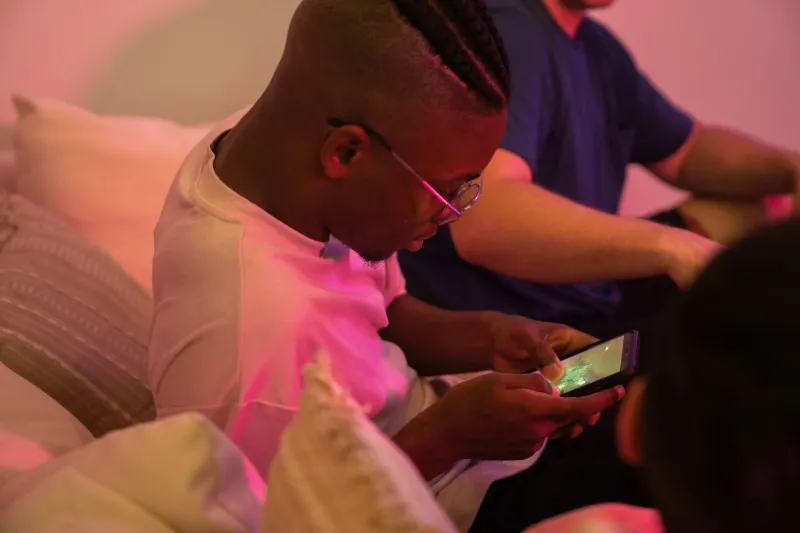
The New Mindful Moment: How Scratch Games Became America's Unexpected Stress Ritual

Somewhere between the third back-to-back Zoom call and the dinner she still needs to plan, Maya — a 34-year-old project manager from Austin — takes two minutes for herself. She doesn't meditate. She doesn't do breathwork. She opens ScratchGames on her phone, plays a couple of rounds, and then gets back to it.
"I know it sounds weird," she says, "but it genuinely resets me. It's like my brain gets a little vacation."
Maya isn't alone. Across the US, a quiet but meaningful shift is happening in how people relate to casual gaming — and scratch games in particular. What started as a novelty entertainment category is being consciously repurposed by players as a tool for stress management, mental decompression, and something that looks a lot like mindfulness, even if nobody calls it that.
The Pressure Cooker Moment America Is Living In
To understand why this trend is happening now, you have to look at the environment it's emerging from. American workers are logging longer hours than ever, with the boundary between professional and personal life increasingly dissolved by smartphones and remote work culture. The American Psychological Association's annual Stress in America survey has consistently shown elevated stress levels tied to work, finances, and the relentless pace of digital life.
Mindfulness apps exploded in popularity for exactly this reason — millions of Americans downloaded Calm and Headspace in search of something that could create a mental pause in a day that never really stops. But for a lot of people, sitting quietly and focusing on breath just doesn't click. It requires a specific kind of stillness that doesn't come naturally to everyone.
Scratch games, it turns out, offer a different path to a similar destination.
What Actually Happens in Your Brain During a Scratch Session
Dr. Priya Menon, a behavioral psychologist based in Chicago who studies leisure and stress recovery, explains the appeal in terms of attentional focus. "Effective stress relief requires what psychologists call 'attentional absorption' — the state where your mind is fully occupied by something that isn't your stressor," she says. "You can achieve that through meditation, but you can also achieve it through a game that demands just enough focus to crowd everything else out."
Scratch games hit a specific neurological sweet spot. They're engaging enough to capture attention completely — the suspense of the reveal, the tactile satisfaction of the scratch mechanic, the micro-moment of anticipation — but not complex enough to create their own stress. There's no learning curve to navigate, no failure state to dread, no skill gap to close. You show up, you play, you find out what happened.
That simplicity is the feature, not the limitation. "The games that work best as mental breaks tend to be ones with clear beginnings and endings and low cognitive load," Dr. Menon notes. "A two-minute scratch game session has a defined arc. That structure is actually quite soothing for an overstimulated nervous system."
The Tactile Factor Nobody Talks About Enough
There's something else going on that's easy to overlook: the physical act of scratching.
Even in digital format, scratch games replicate a gesture that is, at its core, satisfying in a very primal way. The drag of a finger across a screen, the reveal happening layer by layer — it engages the senses in a way that purely visual content doesn't. Occupational therapists have long recognized the stress-relieving properties of repetitive tactile actions; it's part of why fidget tools, stress balls, and textured sensory objects have clinical applications.
Jordan, a 28-year-old graphic designer from Portland, describes his scratch game habit in almost sensory terms. "It's not really about winning. It's about that moment of scratching and seeing what's underneath. There's something satisfying about it that I can't fully explain."
He's right that it's hard to explain — but it's not hard to understand. The reveal mechanic creates a tiny loop of anticipation and resolution that the brain finds genuinely pleasurable to complete. Over and over, that loop delivers a small, clean sense of closure. In a workday full of open threads and unresolved tasks, that closure is worth something.
Intentionality Is the Key Ingredient
What separates the players who experience scratch gaming as a genuine wellness tool from those who don't isn't the game itself — it's the intention they bring to it.
Players who describe the most positive, restorative experiences tend to play with deliberate structure. They set a time limit before they start. They choose a comfortable physical environment — a favorite chair, outside on a lunch break, away from the work desk. They treat it as a transition ritual: a signal to the brain that work mode is pausing and rest mode is beginning.
This mirrors what mindfulness researchers call "contextual cueing" — the way specific environments and routines help the brain shift between cognitive states. Your lunch break scratch session isn't just entertainment; it's a neurological signal that you're allowed to stop for a minute.
"The ritual aspect is underrated," says Dr. Menon. "Humans have always used rituals to mark transitions and create psychological safety. Whether it's a cup of tea, a short walk, or a quick game — what matters is that it's consistent and intentional. That's what makes it restorative rather than just distracting."
The Important Distinction
It's worth being direct about something: the wellness benefits players describe are real, but they depend on the game staying in its lane as a brief, bounded break rather than an extended escape. Two minutes of scratch gaming as a mindful reset is a genuinely different thing from an hour of play motivated by stress or chasing losses.
The players who seem to get the most out of this habit are the ones who've thought about it clearly. They know why they're playing, how long they're going to play, and what they're getting out of it. That self-awareness is the wellness practice — the game is just the vehicle.
A New Kind of Break Culture
America has always had complicated feelings about rest. Taking breaks can feel unproductive, indulgent, or hard to justify. But the science on cognitive restoration is unambiguous: short, genuine mental breaks improve focus, decision-making, and overall productivity. The challenge is finding breaks that actually work — that create real mental distance from work rather than just swapping one screen for another.
For a growing number of Americans, a quick scratch game session is threading that needle. It's engaging enough to pull attention away from work stress, short enough to fit into any schedule, and satisfying enough to feel like a real reward rather than a guilty distraction.
Maya from Austin puts it simply: "I come back to my desk feeling like I hit a little reset button. It works for me."
Sometimes the most effective wellness tool is the one you'll actually use. Scratch that.